
The ECGT Directive (Empowering Consumers for the Green Transition, Directive 2024/825) is an EU law that fundamentally changes how businesses can market environmental claims. If your company makes green claims on its website, packaging, or advertising, you need to understand this directive before enforcement begins on September 27, 2026.
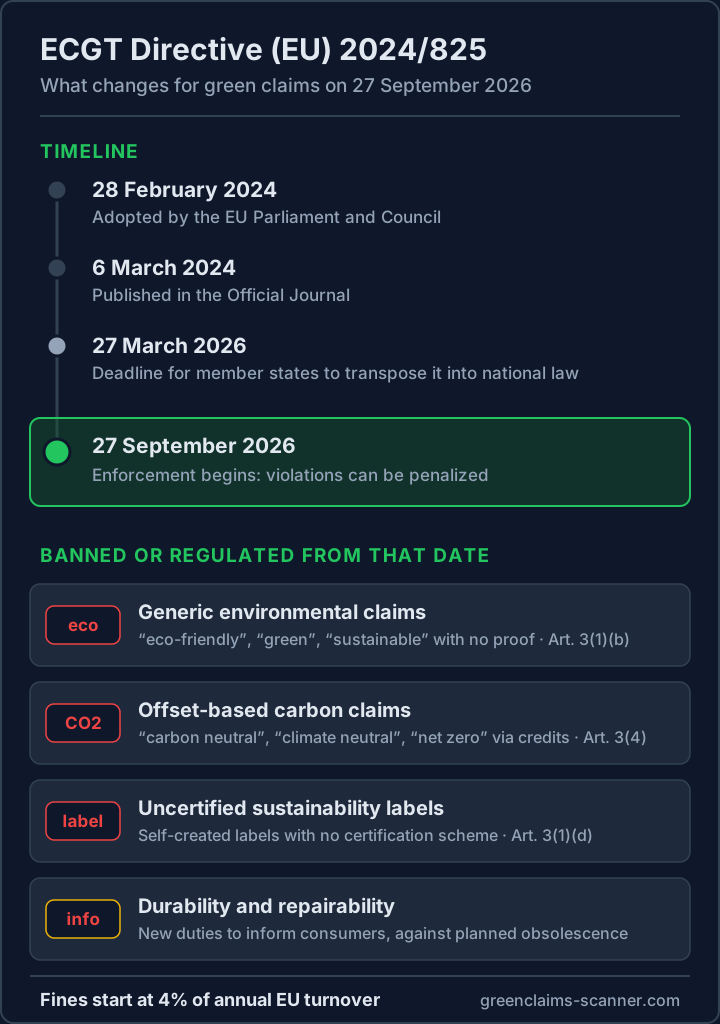
What Is the ECGT Directive?
The ECGT Directive amends the Unfair Commercial Practices Directive (2005/29/EC) and the Consumer Rights Directive (2011/83/EU). It was adopted on February 28, 2024 and published in the Official Journal on March 6, 2024.
Its primary goal: ban misleading environmental claims that cannot be substantiated with verifiable evidence. The directive targets greenwashing — the practice of making vague, exaggerated, or false green claims to attract environmentally conscious consumers.
Key Provisions
1. Ban on Generic Environmental Claims (Art. 3(1)(b))
Traders may not make generic environmental claims such as “eco-friendly”, “green”, “sustainable”, or “environmentally friendly” unless they can demonstrate recognized excellent environmental performance relevant to the claim. In practice, this means EU Ecolabel certification or equivalent.
2. Ban on Offset-Based Carbon Claims (Art. 3(4))
Environmental claims based on greenhouse gas emission offsetting are prohibited. Claims like “carbon neutral”, “climate neutral”, or “net zero” that rely on purchasing carbon credits are banned. Companies must demonstrate actual emission reductions.
3. Sustainability Labels Must Be Certified (Art. 3(1)(d))
Sustainability labels displayed on products must be based on a certification scheme or established by public authorities. Self-created sustainability labels without third-party verification are banned.
4. Durability and Repairability Information
The directive introduces requirements around informing consumers about the durability and repairability of products, combating planned obsolescence claims.
Who Is Affected?
Any business that:
- Sells products or services to EU consumers
- Makes environmental claims on their website, packaging, advertising, or social media
- Uses sustainability labels or certifications
- Includes terms like “eco”, “green”, “sustainable”, “carbon neutral” in marketing
This includes non-EU companies selling into the EU market.
Penalties
Member states set their own penalties, but the directive mandates they must be “effective, proportionate and dissuasive.” The directive references fines of up to 4% of annual turnover in the relevant member state(s). Some countries go higher: Italy caps fines at €10 million per violation; France adds criminal liability up to 2 years imprisonment for repeat offenders.
Timeline
| Date | Event |
|---|---|
| February 28, 2024 | ECGT Directive adopted by EU Parliament and Council |
| March 6, 2024 | Published in Official Journal (Directive 2024/825) |
| March 27, 2026 | Deadline for member states to transpose into national law |
| September 27, 2026 | Enforcement begins — violations can be penalized |
Member State Transposition Status (September 2026)
As of September 2026, the directive is being transposed across all 27 EU member states ahead of the September 27 enforcement date. Germany completed full transposition in January 2026. France, the Netherlands, and Italy are in advanced legislative stages. Businesses operating across multiple EU markets should monitor each jurisdiction’s national implementing measures, as penalty frameworks vary significantly between member states.
How to Prepare
- Audit your claims: Scan your website, packaging, and marketing materials for any of the 28 banned or restricted terms. Our free Green Claims Scanner does this automatically in under 60 seconds.
- Gather evidence: For each environmental claim, ensure you have verifiable, third-party substantiation
- Remove or replace: Generic claims should be replaced with specific, measurable statements
- Get certified: Consider EU Ecolabel or recognized industry certifications for products/services
- Monitor continuously: Set up automated scanning to catch new claims introduced by marketing teams
ECGT vs. Green Claims Directive (GCD)
The Green Claims Directive (GCD) was a separate legislative proposal that would have required pre-approval of environmental claims. It was withdrawn in June 2025. The ECGT Directive is the binding law that companies must comply with. There is no pre-approval requirement — companies must self-certify and demonstrate compliance if challenged.
In-Depth ECGT Articles
Explore each aspect of the ECGT Directive in detail:
- ECGT Directive 2024/825 Explained — full breakdown of the legal text and what it means for your business
- ECGT Enforcement Date: September 2026 — timeline and preparation milestones
- ECGT Penalties & Fines — what you risk for non-compliance (up to 4% turnover)
- ECGT Enforcement by Member State — country-by-country status, transposition deadlines, and penalty frameworks
- ECGT Compliance Checklist — step-by-step preparation guide
- ECGT vs Green Claims Directive — understanding the differences between the two EU proposals
- ECGT Impact on E-commerce — specific implications for online retailers
- Greenwashing Fines & Penalties 2026 — real enforcement cases with fine amounts by country
Related Resources
- Complete List of 28 Banned Green Terms — every term regulated by the ECGT, with compliant alternatives
- How to Detect Greenwashing — 5-step guide to identifying misleading claims
- Green Marketing Without Greenwashing — how to market sustainability compliantly
Frequently Asked Questions
What is the ECGT Directive?
The ECGT (Empowering Consumers for the Green Transition, Directive 2024/825/EU) is an EU law adopted in February 2024 that bans misleading environmental claims. It prohibits generic terms like “eco-friendly” and “sustainable” without substantiation, offset-based carbon neutrality claims, and unverified private sustainability labels.
When does the ECGT come into force?
The ECGT enforcement date is September 27, 2026. By that date, all 27 EU member states must have transposed the directive into national law. Germany completed transposition in January 2026; France, Netherlands, Italy, and others are in advanced stages as of September 2026.
Can my company still say “carbon neutral” after September 2026?
Not if the claim is based on carbon offset purchasing. The ECGT explicitly prohibits carbon neutrality claims that rely solely on offsets. Claims based on actual, verified emission reductions across the full product lifecycle may be permissible with proper third-party documentation.
Does the ECGT apply to non-EU companies?
Yes. Any trader making environmental claims to consumers in the EU market must comply, regardless of where they are headquartered. US, UK, and Asian companies selling into EU markets fall within scope.
What are the maximum ECGT penalties?
The directive mandates at least 4% of annual EU turnover for systematic infringements. Member states can set higher penalties: Italy caps fines at €10 million per violation; France adds criminal liability with up to 2 years imprisonment; Ireland sets maximums at €10 million or 4% of turnover.
How do I know if my green claims are ECGT-compliant?
Use the Green Claims Scanner for a free automated audit of your website. It checks every page against the 28+ banned and restricted terms under the ECGT and generates a detailed compliance report in under 60 seconds. For claims you want to keep, each needs documented, third-party-verifiable scientific substantiation.
When exactly does ECGT enforcement begin?
ECGT enforcement begins on September 27, 2026. Companies that have not yet audited their environmental marketing claims should prioritize this immediately. Use the free Green Claims Scanner to start with an automated website audit in under 60 seconds.